Why 2026’s Most Talked-About Comic Runs Are Abandoning Traditional Paneling
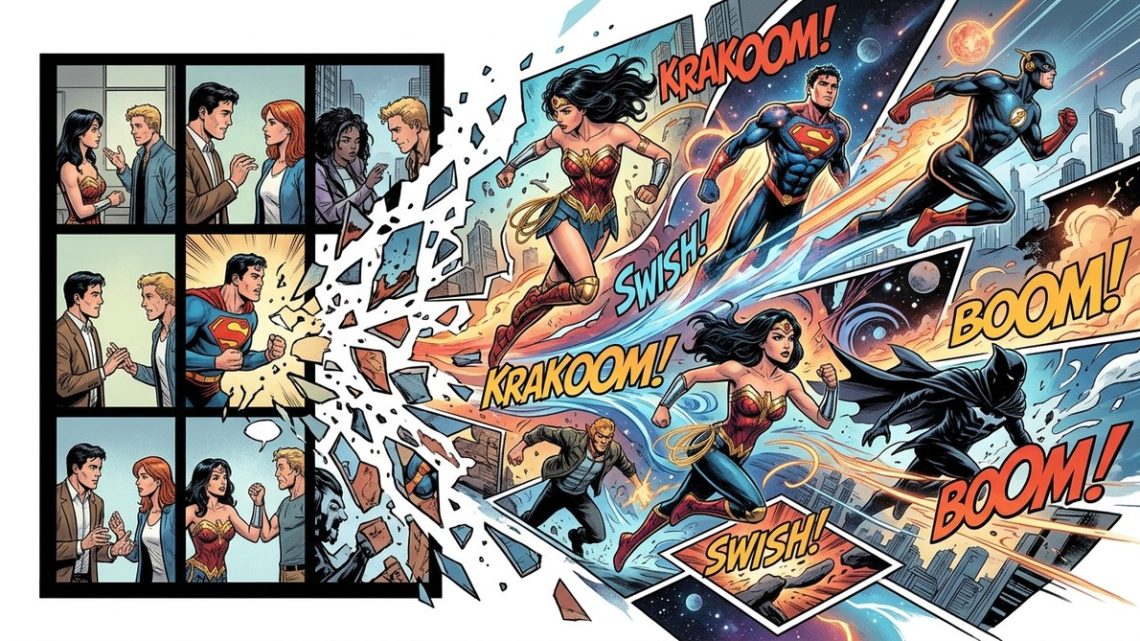
The first time you open a comic and find no borders, no tidy squares, no gutters at all, it can feel a little like walking into a room where the walls have vanished. Your eye has nowhere to anchor. The story spills across the page in a single continuous image, or it breaks into floating fragments that seem to ignore every rule you learned from reading superhero monthlies. This is the reality of comics without traditional panels, and in 2026, it has become the defining visual signature of the year’s most talked about runs. Artists are not just bending the grid anymore. They are abandoning it.
The shift away from rigid paneling in 2026 is not a gimmick. Top creators are using borderless layouts to control reading speed, mirror digital scrolling habits, and create emotional immersion that a traditional grid cannot match. For readers and collectors, this changes how we evaluate art, pacing, and even the value of a page.
Why the Grid Is Disappearing
The standard nine panel grid served comics well for decades. It gave readers a predictable rhythm. You read left to right, top to bottom, and the story moved forward like a metronome. But that predictability comes at a cost. It trains the eye to skim. It flattens emotion into uniform boxes.
In 2026, the most exciting runs are treating the page like a canvas instead of a series of windows. Artists like Daniel Warren and Liana K. have built entire issues around a single composition where characters move through time without the interruption of a border. This technique forces you to slow down. You have to search for the next moment. The reading experience becomes active rather than passive.
The influence of webcomics and vertical scrolling platforms like Webtoon has pushed this trend hard. Readers who grew up swiping on their phones expect a different visual language. Print comics are responding by adopting a more fluid, scroll like approach on paper. If you want to see how digital habits are reshaping the industry, check out our piece on the rise of digital comics in 2026.
How to Read a Panel Free Comic
Reading a comic without traditional panels is a skill. Your brain wants to find the grid. Here is a simple process to retrain your eye.
- Scan the whole page first. Before you read any dialogue, look at the full spread. Notice where the darkest areas are. Those are usually where the action peaks. Light areas often signal quiet moments or transitions.
- Follow the characters’ eyelines. When panels disappear, character gazes become your guide. If a character looks to the bottom right, the story is pulling you that way. If they look up, your eye follows.
- Use color shifts as punctuation. A sudden change in background color often works like a panel break. It tells you the scene or time has shifted.
- Look for negative space. Empty areas on the page act like gutters. They give you a mental pause before the next beat.
- Read the lettering placement. In a borderless layout, word balloons become part of the composition. They can float freely or sit inside the art. The order of the balloons is your roadmap.
Common Techniques for Panel Free Storytelling
Creators are using several distinct methods to replace the grid. Each one changes how the story feels.
| Technique | How It Works | Best For |
|---|---|---|
| Bleeding edges | Art runs off the page on all sides | Immersion and scale |
| Floating panels | Elements sit on a blank or textured background | Dream sequences and memory |
| Continuous landscape | One image spans multiple pages | Travel and chase scenes |
| Color coded zones | Background colors separate scenes | Fast cuts between locations |
| Embedded moments | Smaller images sit inside a larger image | Flashbacks or parallel action |
The Big Mistake Beginners Make
The most common error new artists try when they abandon panels is forgetting about pacing. A traditional grid controls timing naturally. Without it, you have to build rhythm through composition alone.
“A page with no panels still needs a beat. You cannot just throw every character onto one big background and call it a day. The eye needs a path. If you do not provide one, the reader will feel lost within three pages.” — Marcus Chen, Eisner nominated artist
That advice applies to readers too. When you feel confused by a panel free page, ask yourself if the artist gave you a path or just a mess. The best runs make the path invisible. You follow it without thinking.
Why Collectors Are Paying Attention
For collectors, the move away from traditional panels creates a shift in what makes a page valuable. A standard page with nine panels is impressive for consistency. A borderless page is impressive for composition and risk. Original art from these runs is already commanding higher prices because each page is a standalone piece of art.
If you are building a collection in 2026, you should pay attention to how an artist handles space. Pages that use the full canvas without borders often translate better to prints and displays. They look less like a comic page and more like a poster. For tips on building a smart collection, read our guide on how to build a comic collection on a budget in 2026.
Titles Leading the Charge
Several series have become the standard bearers for this movement. The Drift by Avery Holt uses a continuous horizontal scroll across every page. There are no panel borders, only color gradients that shift as the protagonist moves through different emotional states. Bone Orchard by Samira Nader alternates between full page bleeds and tiny floating images that look like Polaroids scattered on a table. Zero Hour by T.J. Park abandons panels entirely for a single massive image that folds across the center spread, with word balloons acting as the only structure.
These titles are not just experiments. They are selling out. Readers are hungry for something that feels new. If you want to know what is coming next, take a look at our list of 10 comic book artists redefining visual storytelling in 2026.
What This Means for the Future
The panel is not dead. It will never disappear completely. Action comics and superhero team books still benefit from the clarity of a grid. But the dominance of the panel as the default unit of comic storytelling is fading. More and more artists are treating the page as a single composition rather than a collection of windows.
This shift mirrors what happened in animation when studios moved away from rigid storyboards toward more fluid, cinematic framing. It changes how stories are written too. Writers now think about visual flow before dialogue. They leave room for the art to breathe.
For readers, this means we are entering a golden age of visual experimentation. Every new issue is an opportunity to see someone try something you have never seen before. That is exciting. That is worth paying attention to.
Your Next Step in Panel Free Comics
If you want to understand this trend, the best thing you can do is pick up one of the series mentioned above and read it with a fresh eye. Do not rush. Let the art guide you. Notice where your eye goes first, second, and last. Compare that experience to reading a traditional superhero book. You will feel the difference immediately.
This is a moment in comics where the form itself is being questioned. That does not happen often. The last time we saw this level of experimentation was the underground comix movement of the late 1960s. We are living through a similar shift right now. The only difference is that this time, the mainstream is paying attention.
If you are new to comics entirely, start with our top 10 must-read comics for new fans guide. If you want to track where the industry is heading, keep an eye on the indie publishers. They are the ones taking the biggest risks, and those risks are shaping the future of every comic you will read in the next decade.