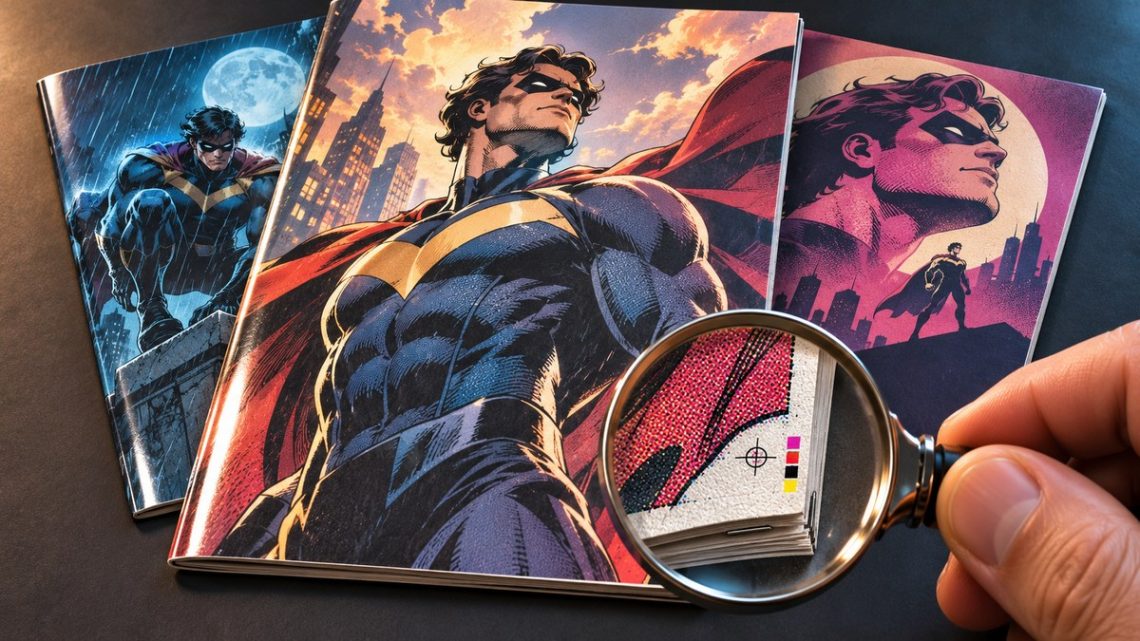
How to Spot a First-Print Variant Cover Without a Price Guide
You walk into a comic shop, spot a variant cover that looks clean, and your gut says it could be a first print. But without a price guide in hand, how do you really know? The difference between a first print variant and a later reprint can mean hundreds of dollars in value. The good news is that the comic itself gives you all the clues you need. You just need to know where to look.
You can identify a first print variant cover without a price guide by checking the barcode box for a missing price, examining the copyright line for a single date, looking for a “1st Printing” notation on the inside front cover, and feeling the cover stock. These physical clues never lie.
What Makes a Variant Cover a First Print
A variant cover is an alternate cover released for the same comic issue. Publishers like Marvel, DC, and Image often print a main cover and several variant covers for a single issue. The first print run includes all of those variants. When a comic sells out, the publisher orders a second print (or third, fourth, and so on). Those later prints usually reuse the most popular variant cover art, which is where confusion starts.
A second print variant can look identical to a first print variant at a glance. The cover image might be the same. The interior story is the same. But the print number changes everything for collectors. First print variants are rarer and more valuable. Later prints are cheaper and more common. Learning to spot the difference without a price guide saves you money and keeps you from overpaying.
The Physical Clues That Identify First Print Variants
You do not need a magnifying glass or a grading service. Your eyes and hands are enough. Here are the most reliable physical indicators.
1. Check the Barcode Area
The barcode box is your best friend. On a first print variant, the barcode area often has no price printed on it. Publishers usually put the cover price on the main cover, not on variant covers. If you see a barcode with no dollar amount next to it, that is a strong sign of a first print variant.
On later prints, the barcode box frequently includes a small notation like “2nd Printing” or “3rd Printing” printed right next to the barcode. Sometimes you will see a small diamond shape or a number inside a circle. Look closely at that rectangle in the bottom corner.
- No price in the barcode box = likely first print variant
- A tiny “2nd Print” text near the barcode = later printing
- A diamond or star symbol = check for a reprint indicator
2. Examine the Copyright and Indicia
Open the comic to the first inside page. Look for the small text block called the indicia. It usually appears on the first or second page, near the bottom. The copyright line will list the year of publication. A first print variant shows only one year. A later print might show a range like “2025, 2026” to indicate the original copyright and the reprint year.
Some publishers add a line that says “First Printing: January 2026” or “Printed in the USA, 1st Printing.” If you see a specific printing number stated there, you have your answer. If the indicia says “Second Printing” or “Third Printing,” put the book back unless the price is right for a reprint.
3. Feel the Cover Stock
First print variants often use a thicker, glossier paper stock than later prints. Publishers sometimes cut costs on reprints by using thinner cardstock. Hold the comic next to a known first print from the same series. Does the cover feel flimsy? Does it bend more easily? If the cover feels cheap, it might be a later print.
This trick works best when you have a comparison copy. But even without one, you can develop a feel for the standard stock used by each publisher. Marvel first prints tend to have a firm, waxy finish. DC first prints often feel slightly textured. Image first prints vary widely, but they rarely feel thin.
A Step-by-Step Process to Verify a Variant Cover
Follow this numbered checklist when you pick up a variant cover at a shop or convention.
- Flip to the barcode. Look for a price. If there is no price, move to step two. If you see a price, check for a small printing number near the barcode.
- Open to the indicia. Read the copyright line. Look for the words “First Printing,” “Second Printing,” or any date range.
- Check the inside front cover. Some publishers, especially Image and Boom Studios, stamp the printing number on the inside of the front cover. This is often a small number in a circle or a line of text.
- Feel the cover stock. Compare the weight and flexibility to another comic from the same series if possible.
- Look for a diamond or star. DC Comics sometimes uses a diamond symbol on the cover of later prints. Marvel sometimes uses a small star. These symbols are not always present, but when you see one, it usually means a reprint.
“The barcode box tells the story. If there is no price and no tiny print number, you are probably holding a first print variant. That is the single most reliable rule I teach new collectors.” — A longtime comic shop owner from Portland, Oregon
Common Mistakes When Identifying Variant Printings
Even experienced collectors slip up. Here is a table of frequent errors and how to avoid them.
| Mistake | Why It Happens | How to Avoid It |
|---|---|---|
| Confusing a retailer incentive variant with a reprint | Incentive variants look different but are still first prints | Check the barcode for a price; incentive variants usually lack one |
| Assuming all variants without a price are first prints | Some later prints also drop the price | Always verify the indicia or inside cover notation |
| Ignoring the cover stock difference | Later prints can mimic the same art at a glance | Feel the paper; if it feels thin, be skeptical |
| Trusting the cover date alone | Cover dates often do not match print runs | Use the copyright line for the real date |
| Forgetting that digital codes affect value | Some first prints include a digital code; later prints may not | Look for a code sheet inside; its absence might mean a reprint |
What to Do When the Clues Conflict
Sometimes a comic will have no price in the barcode box but a copyright line that says “Second Printing.” That is rare, but it happens. When clues conflict, trust the indicia and the inside cover stamp over the barcode. Publishers are more consistent with their printing notations than with barcode design.
If you are still unsure, check online databases on your phone. Many comic shops have free Wi-Fi. Look up the issue number and variant on a site like League of Comic Geeks or the Grand Comics Database. But remember, the goal of this guide is to help you avoid relying on those tools. Use them only as a backup.
How Reprints Affect Variant Cover Value
A first print variant of a hot key issue can sell for ten times the cover price or more. A second print of the same variant usually sells for near cover price or less. The only exception is when a second print itself becomes scarce, but that is uncommon.
If you are buying to resell, always confirm the printing before you pay. If you are buying for your personal collection, a later print might be just fine. But you should still know what you are buying. Knowing the difference between a first print variant and a reprint keeps you in control of your collection and your budget.
For more on the broader market, check out how collectors are shaping the future of comic book markets. Understanding the forces behind pricing helps you make smarter buys.
Why This Skill Matters More in 2026
The comic market has changed. Reprints happen faster than ever. A popular variant cover might get a second print within weeks of release. Publishers are also experimenting with foil covers, virgin covers, and other special treatments. These premium variants are almost always first prints, but reprints of simpler variants can sneak onto shelves.
Knowing how to identify first print variant covers without a price guide gives you an edge. You can shop at flea markets, estate sales, and small conventions where price guides are not handy. You can also spot a deal when a seller mislabels a reprint as a first print.
If you are new to collecting, read our guide on how to build a comic collection on a budget in 2026. It pairs well with the skills you are learning here.
Put Your New Skills to Use
The next time you hold a variant cover, run through the checklist. Look at the barcode. Open to the indicia. Feel the paper. You will be surprised how quickly these habits become automatic. Within a few months, you will be able to identify a first print variant in seconds.
Comic collecting is part knowledge, part instinct. This method builds both. You do not need a subscription to a price guide or a grading service. You just need your eyes, your hands, and a little patience.
Happy hunting out there. Your next great find is waiting on a shelf.