The Secret Origins of the Most Iconic Comic Book Sidekicks
The first sidekick didn’t start as a beloved partner. He started as a sales gimmick. In 1940, DC Comics needed a way to keep young readers buying Batman comics. Their solution was a bright green, red, and yellow distraction named Robin. That single decision changed the superhero genre forever. But the road from that first circus acrobat to the complex legacy characters we know today is full of surprising twists, tragic deaths, and creative reinventions. Let’s pull back the cape on the real origins of the most famous comic book sidekicks.
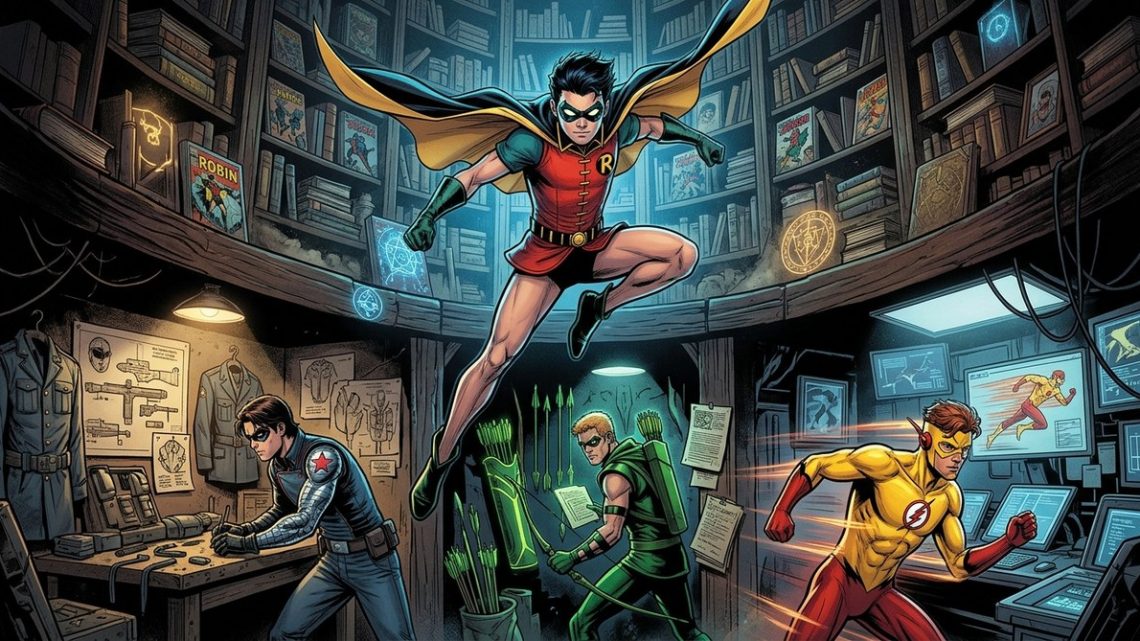
Sidekicks were invented to boost sales and give younger readers a character to identify with. Over time, these partners grew into independent heroes, often carrying stories that rivaled their mentors. The origins of Robin, Bucky, Speedy, and others reveal how comic book sidekicks evolved from disposable plot devices into some of the most enduring figures in pop culture.
The Birth of the Boy Wonder
Before 1940, Batman fought crime alone. Editor Whitney Ellsworth suggested adding a younger character to attract kids. Bob Kane and Bill Finger created Robin, inspired by the legend of Robin Hood and the look of a young circus performer named Dick Grayson. The character was an instant hit. Sales doubled.
What many fans don’t realize is that the original Robin was not a carbon copy of Batman. Dick Grayson brought acrobatic flair and a lighter tone to the Dark Knight’s world. He was the light to Batman’s shadow. This dynamic became the blueprint for nearly every sidekick that followed.
“Robin was created to give Batman someone to talk to. Without Robin, Batman would have been a grim figure in a dark alley with no one to bounce off. The sidekick made the hero human.” — Mark Waid, comic book writer
Bucky Barnes: The Sidekick Who Died (and Came Back)
When Joe Simon and Jack Kirby created Captain America in 1941, they knew they needed a way to keep the action grounded. Bucky Barnes started as the camp mascot for the US Army, a teenager who stumbled onto Captain America’s secret identity. He was not a trained fighter at first. He was a lucky kid who got caught up in the war.
Bucky’s death in 1964’s The Avengers #4 was a landmark moment. It proved that sidekicks could die permanently, or so readers thought. The character stayed dead for decades until Ed Brubaker revived him as the Winter Soldier in 2005. That story arc redefined what a sidekick could become: a brainwashed assassin, a rival, and eventually a hero in his own right. Bucky’s journey from mascot to Captain America himself is one of the most dramatic transformations in comics.
Speedy and the Struggle for Relevance
Roy Harper, better known as Speedy, debuted in 1941 as Green Arrow’s ward. He was a direct copy of the Robin formula: a young archer with a matching costume. For years, Speedy existed in Green Arrow’s shadow. He had little personality beyond being “the kid who shoots arrows.”
Everything changed in 1971. In Green Lantern/Green Arrow #85, Speedy revealed a heroin addiction. It was a shocking, adult story that dealt with real world problems. The character went to rehab, changed his name to Arsenal, and later became the leader of the Teen Titans. Speedy’s origin story is a lesson in how sidekicks can grow up and face mature challenges.
A Table of Sidekick Evolution
The following table breaks down how three major sidekicks evolved from their original roles to modern interpretations.
| Sidekick | Original Role | Key Turning Point | Modern Status |
|---|---|---|---|
| Robin (Dick Grayson) | Circus acrobat, Batman’s ward | Left Batman to become Nightwing | Leader of the Titans, own identity |
| Bucky Barnes | Army mascot, Captain America’s partner | “Death” in 1964, revival as Winter Soldier | Captain America, solo hero |
| Speedy (Roy Harper) | Green Arrow’s copycat sidekick | Heroin addiction storyline (1971) | Arsenal, team leader, father |
Why Sidekicks Were So Important
Sidekicks served a practical purpose for publishers. They gave younger readers a character their own age to root for. They also allowed writers to explain plot points through a character who needed things spelled out. But the real magic happened when creators started treating sidekicks as real people.
Consider these three functions of the classic sidekick:
- The emotional anchor. Sidekicks often humanize the hero. Batman is cold; Robin is warm. Captain America is a symbol; Bucky is a soldier with doubts.
- The risk factor. A sidekick in danger raises the stakes. Readers care more when a child or teenager is threatened than when an invincible adult is in trouble.
- The legacy carrier. When a sidekick grows up, they carry the hero’s values forward. Dick Grayson became Nightwing. Bucky became Captain America. Wally West became the Flash.
How to Trace a Sidekick’s Origin Yourself
If you want to research the origins of any sidekick, you can follow a simple process. This works for characters from DC, Marvel, or any independent publisher.
-
Find the first appearance. Look up the issue number and year the character debuted. Sites like the Grand Comics Database are helpful. For example, Robin first appeared in Detective Comics #38 (1940).
-
Read the first story. The debut issue often reveals the original intent for the character. Was the sidekick a replacement for the hero? A younger sibling? A random kid who saw too much?
-
Track major death or departure points. Sidekicks often leave or die to make room for new characters. These moments are key to understanding their arc.
-
Look for the reinvention. Most classic sidekicks have at least one major reinvention. For Bucky, it was the Winter Soldier. For Speedy, it was the addiction story. For Wally West, it was becoming the Flash.
-
Check the modern status. See how the character is used today. Are they leading a team? Starring in a solo book? Appearing in movies or shows? This tells you how the character has grown.
The Surprising Role of Kid Sidekicks in the 1960s
The Silver Age of Comics brought a flood of new sidekicks. DC introduced Aqualad, Kid Flash, and Wonder Girl. Marvel countered with the X-Men, who were essentially a team of sidekicks without a central hero. The trend peaked with the creation of the Teen Titans in 1964, a team made entirely of sidekicks.
What is less known is that these characters were often created to fill a legal need. DC wanted to trademark character names and concepts. A sidekick with a similar name to the hero could help secure those trademarks. Kid Flash protected the Flash name. Aqualad protected Aquaman. It was a business move wrapped in a colorful costume.
Sidekicks Who Became More Famous Than Their Mentors
Some sidekicks outgrew their original roles completely. Dick Grayson is the prime example. He became Nightwing, led the Teen Titans, and even served as Batman for a time. Wally West, the third Kid Flash, became the primary Flash for over two decades and is considered by many fans to be the definitive version.
Other examples include:
- Wolverine. He started as a Hulk villain and a member of the X-Men, but his popularity quickly eclipsed the team. He is now more recognizable than most of his mentors.
- Spider-Man’s sidekicks. Characters like Spider-Gwen and Miles Morales began as alternate universe sidekicks but now headline major films and comics.
- Batgirl. Barbara Gordon started as a female counterpart to Batman, but her time as Oracle and her solo series made her a fan favorite independent of the Bat.
For more on how these characters fit into the bigger picture, check out our guide on top 10 must-read comics for new fans.
The Forgotten Sidekicks
Not every sidekick found lasting fame. Some disappeared into comic book history. Consider these examples:
- Sandy the Golden Boy. He was the sidekick to the Sandman (Wesley Dodds) in the 1940s. Sandy was later retconned into a villain and then a hero again, but he never reached the same level as Robin.
- Hector Hall. He was the Silver Age sidekick to the Golden Age Sandman, but only appeared in a handful of issues.
- Rick Jones. He was the teenage sidekick to the Hulk, Captain America, and the Avengers at various points. He never developed a strong identity of his own.
These characters remind us that the sidekick formula does not always work. A character needs a strong personality, a clear role, and a compelling arc to survive.
How Modern Comics Reimagine the Sidekick
Today’s writers approach sidekicks differently. They avoid the simple “kid in a matching costume” trope. Modern sidekicks often have their own codenames, costumes, and motivations. They are not just extensions of the hero.
For example, in the 2020s, DC introduced Damian Wayne as the new Robin. He was raised by assassins and had a violent streak. He was not a cheerful distraction. He was a challenge for Batman. Marvel’s Kate Bishop, who took over as Hawkeye, was a wealthy young woman who trained herself to be a hero. She had no direct connection to Clint Barton’s past.
The trend is toward independence. Sidekicks now leave the nest faster and build their own legacies. This reflects a shift in audience expectations. Readers want characters who grow, change, and stand on their own.
A Final Look at the Sidekick’s Future
The role of the sidekick is not dying. It is evolving. In 2026, we see sidekicks appearing in animated series, live action movies, and video games more than ever. The success of shows like Teen Titans Go! and films like The Batman (which featured a young Robin in the sequel setup) prove that audiences still love the dynamic.
But the sidekick is no longer a second class character. They are co-stars, leaders, and sometimes the main attraction. The secret origins of these characters show us that the best sidekicks were never meant to stay in the shadows. They were always destined to step into the light.
If you want to see how sidekick stories connect to larger trends, read our piece on how collectors are shaping the future of comic book markets. It shows how first appearances of sidekicks are driving modern collecting habits.
The Sidekick Legacy Lives On
The next time you pick up a comic featuring Robin, Bucky, or Speedy, remember that you are reading a character with a history that spans decades. These characters started as sales tools, grew into symbols of hope, and became the backbone of some of the greatest stories ever told. Their origins are messy, surprising, and deeply human. That is what makes them worth knowing.