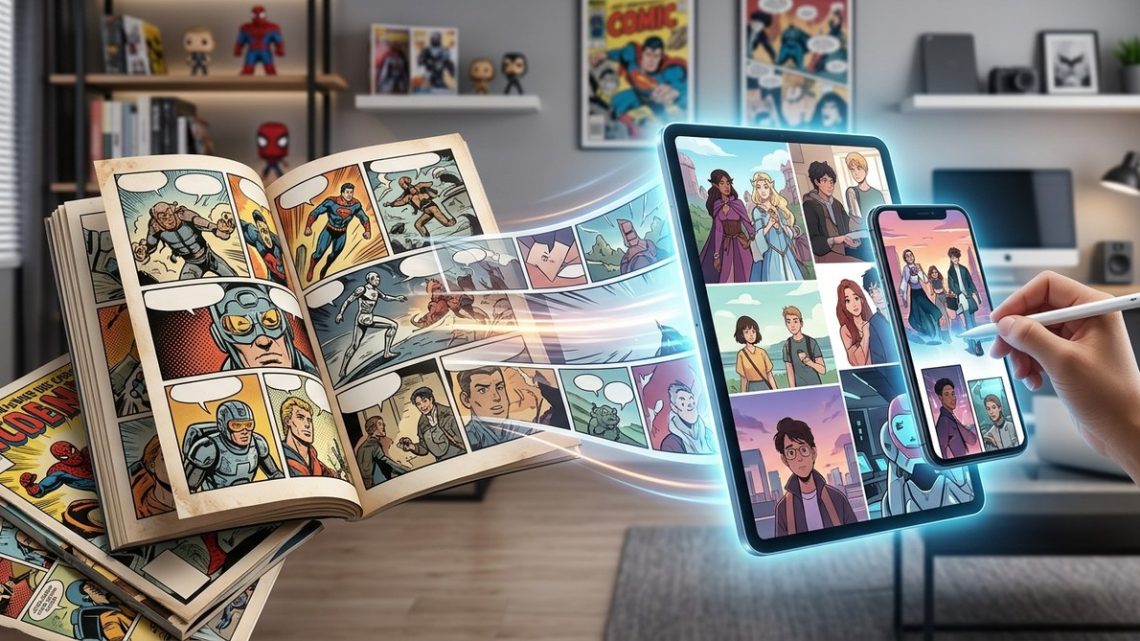
Why the Comic Industry’s Shift to Webtoons Is Changing How Stories Are Told
The way we read comics has changed. You might still love the smell of a fresh issue and the feel of thick, glossy paper. But more and more readers are turning to their phones for their next fix. The comic industry webtoons storytelling movement is not a passing trend. It is a structural shift. Platforms like Webtoon and Tapas have turned scrolling into a reading habit for millions. And this has forced creators and publishers to rethink how a story is built from the ground up.
Webtoons are not just digital comics. They are a new narrative format built for mobile devices. The vertical scroll changes pacing, panel layout, and how readers experience a story. For creators and publishers, this means adapting to shorter chapters, cliffhanger driven arcs, and a direct to audience release model that rewards consistency over monthly issues.
How Vertical Scrolling Changed Pacing
Traditional comics use the page turn as a natural beat. You finish a panel, flip the page, and get a moment of suspense. Webtoons remove that entirely. The reader scrolls down, and the story unfolds in one continuous column.
This changes pacing in a big way. A page turn gives the reader a second to breathe. A scroll does not. So webtoon creators build their stories differently. They use the scroll itself as a tool.
- The reveal. A character walks into a room. The reader scrolls to see the monster hiding in the shadows.
- The speed read. Action sequences flow fast because the reader can scroll through them at their own pace.
- The pause. A single wide panel with a quiet moment forces the reader to stop scrolling and sit with the emotion.
This is not just a digital version of a printed comic. It is a new medium. And it has its own rules.
“A webtoon is not a comic that happens to be on a screen. It is a story designed for an infinite canvas. You have to think in columns, not pages.” (Industry creator, speaking at a 2025 panel on digital narrative design.)
The Chapter Length Revolution
Print comics usually run 20 to 22 pages per issue. That standard has held for decades. Webtoons broke that rule almost immediately.
Most successful webtoons release chapters that take about 5 to 8 minutes to read. That is roughly 40 to 70 panels. The shorter length serves two purposes. It fits the mobile reading habit (waiting for the bus, during a lunch break). And it keeps the reader hungry for the next update.
This shift has changed how writers plan arcs. A print writer might plot a six issue story. A webtoon writer plots a 60 episode season. Each episode needs a small hook. Each episode needs a payoff that feels satisfying on its own.
Here is how the two formats compare in real terms:
| Element | Print Comic (22 pages) | Webtoon Episode (50 panels) |
|---|---|---|
| Reading time | 15 to 20 minutes | 5 to 8 minutes |
| Release schedule | Monthly | Weekly or twice weekly |
| Cliffhanger frequency | One per issue | One per episode |
| Story arc length | 4 to 6 issues | 20 to 40 episodes |
| Production cost per unit | High (printing, distribution) | Low (digital only) |
The weekly release schedule is a key difference. Readers get a small dose of story every week. This builds a habit. And it keeps the conversation alive on social media between chapters.
New Tools for New Storytellers
The comic industry webtoons storytelling boom has opened doors for creators who might never have broken into print. You do not need a publisher. You do not need a distributor. You need a smartphone, a drawing tablet, and a platform account.
This has led to a wave of diverse voices. Stories about queer romance, immigrant families, and mental health have found huge audiences on webtoon platforms. These are stories that traditional publishers often passed on.
Aspiring creators can follow a few practical steps to get started:
- Study the format. Read the top 10 webtoons in your genre. Notice how they use vertical space. Notice where they place their cliffhangers.
- Plan for mobile. Keep your panels narrow. Use large text. Make sure the art reads well on a small screen.
- Release on a schedule. Consistency matters more than perfection. Readers trust creators who show up every week.
- Build a social presence. Post previews on TikTok and Instagram. Talk to your readers in the comments. Webtoon success is often driven by community.
- Monetize early. Platforms offer ad revenue sharing and tipping. Some creators also launch Patreons for early access.
If you are curious about how the broader digital landscape is evolving, check out our guide on the rise of digital comics in 2026.
The Monetization Model Is Different
Print comics rely on the direct market. You sell issues to comic shops, and they sell them to readers. Webtoons use a freemium model. Readers get the first few episodes for free. Then they wait for new episodes or pay to unlock them early.
This changes the financial incentive for creators. In print, you want to sell as many single issues as possible. On webtoons, you want to keep readers engaged over a long period. The longer a reader stays, the more likely they are to spend money on coins or fast passes.
Some creators make a full time living from webtoons. Others use the platform as a portfolio to land publishing deals or animation contracts. The key is building a loyal audience.
For publishers watching this space, the lesson is clear. You can no longer ignore the mobile first reader. Many traditional publishers now release digital first series that mimic the webtoon format. Some even partner with platforms to adapt print properties into vertical scroll stories.
What This Means for Story Structure
The vertical format forces writers to think about visual hierarchy in a new way. In a printed comic, the top left panel is the starting point. In a webtoon, the top of the screen is where you begin. But the reader controls the pace.
This has led to some clever storytelling techniques.
- The long vertical reveal. A character stands at the bottom of a tall building. The reader scrolls up to see the full height. The scroll itself becomes the reveal.
- The split second twist. A panel looks normal. The reader scrolls one line. The next panel shows a completely different angle or time.
- The silent scroll. A sequence with no dialogue. The art tells the whole story. The reader moves through it at their own speed.
These techniques are not possible in print. They are native to the webtoon format. And they are changing how a new generation of creators thinks about visual storytelling.
If you want to see which artists are pushing these boundaries, take a look at our list of 10 comic book artists redefining visual storytelling in 2026.
The Challenges of the Format
Webtoons are not perfect. The format has some downsides that creators and readers should know about.
- Burnout. Weekly release schedules are brutal. Many creators struggle to keep up with the pace.
- Monetization pressure. The freemium model can feel exploitative. Readers may get frustrated by paywalls.
- Algorithm dependency. Platforms control what readers see. A good story can get buried if the algorithm does not favor it.
- Limited page design. The vertical scroll does not allow for complex layouts. Some artists miss the freedom of a two page spread.
Despite these issues, the format continues to grow. Platforms are experimenting with audio narration, animated panels, and even interactive choices. The technology is still evolving.
How Traditional Publishers Are Adapting
Major comic publishers have noticed the shift. Marvel and DC now release digital first content that mimics webtoon pacing. They have also launched original webtoon exclusive series.
But the biggest changes are happening at the indie level. Small publishers are using webtoons to test new ideas before committing to print. A webtoon that gets 10 million views is a safe bet for a collected edition.
This has created a pipeline. Webtoon to print. Digital to physical. It is the reverse of how things used to work.
For collectors, this creates a new kind of scarcity. Early webtoon episodes can become valuable if the series blows up. If you are interested in how to spot valuable first issues in this new landscape, read our guide on how to spot valuable first issues in 2026.
Why This Shift Matters for the Next Decade
The comic industry webtoons storytelling shift is not slowing down. Mobile reading is the default for younger audiences. Gen Z and Gen Alpha have grown up with phones in their hands. They expect stories that fit their screens and their schedules.
This means the traditional 22 page comic will not disappear. But it will become a smaller part of the overall market. The future of comics is multi format. A story might start as a webtoon, move to print, then get adapted into an animated series.
Creators who learn the webtoon format now will have a head start. Publishers who adapt their workflows will survive. Readers will get more stories, more often, from more diverse voices.
Your Next Step as a Creator or Fan
If you are a comic fan, try reading a webtoon this week. Pick a genre you already love. Give it 10 minutes. Notice how the story flows. Notice how you feel when you hit the end of an episode.
If you are an aspiring creator, start small. Draw a 30 panel episode. Post it. See what happens. The barrier to entry has never been lower.
And if you are a professional in the industry, pay attention to the data. The platforms are publishing their readership numbers. The trend is clear. Webtoons are not a side experiment. They are the new mainstream.
For more context on how independent voices are reshaping the market, check out our piece on why independent comics are dominating the industry in 2026.
The page is turning. Or rather, the scroll is moving. And the story is just getting started.