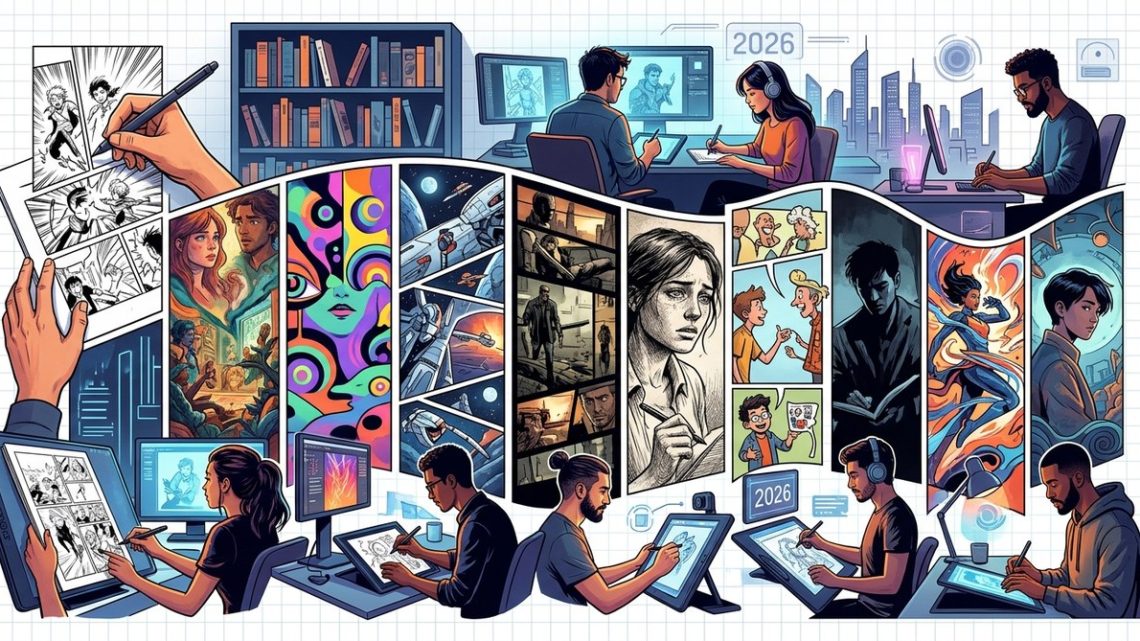
10 Comic Book Artists Redefining Visual Storytelling in 2026
Every few years, the comic industry hits a reset. Styles change. New tools emerge. A fresh generation of artists decides that old rules no longer apply. 2026 is one of those years. The artists on this list are not just drawing comics. They are rebuilding the language of visual storytelling itself. Some use digital brushes in ways that mimic oil painting. Others use negative space to make you feel isolation. A few are mixing mediums that have no business being on the same page. But they all share one thing: they are making the rest of us rethink what a comic can be.
The 10 comic book artists featured here are reshaping the visual language of sequential art in 2026. They blend traditional techniques with new digital tools, challenge conventional panel layouts, and prioritize emotional resonance over hyper realistic detail. For fans and professionals alike, studying their work is the best way to understand where the medium is headed next. These are the artists who will define the decade.
The New Wave of Visual Storytellers
The term “comic book artist” used to mean someone who pencils and inks in a very specific house style. That is no longer true. 2026 is a golden age for experimentation. Publishers like Image, Fantagraphics, and even major houses are taking huge risks on creators with unique visions.
A growing number of these artists credit webcomics and digital platforms for their start. They learned to grab attention in a scroll heavy world. That skill translates directly to print. Pages now have to earn a reader’s focus. A boring splash page gets skipped. The artists below understand this deeply. They treat every page like a poster.
If you are an aspiring artist, watching this wave is essential. The industry is hungry for voices that stand out. These 10 creators are setting the standard for what that looks like.
How These Artists Are Pushing Boundaries
Let’s get into the list. These are the 10 comic book artists you need to have on your radar in 2026. Their work is available now at your local shop or on major digital platforms.
1. Kai Nakamura
Kai’s work is a neon drenched fusion of manga linework and digital airbrushing. Their series Ghost Frequencies uses double page spreads that feel like a glitching computer screen. The narrative is about AI ghosts, but the art makes you feel like you are inside a corrupted hard drive. Kai is a master of visual noise used with precision.
2. Elena Rossi
Elena paints her comics with thick, impasto style brushstrokes. Yes, on paper. Her horror series The Hungry Earth looks like an oil painting that is rotting in front of you. She proves that texture can be a storytelling device. You can almost smell the damp earth and decay. It is visceral in a way that digital art rarely achieves.
3. Marcus T. Williams
Marcus works in pure geometric abstraction for action scenes. His sci-fi epic Algorithmic Gods features battle sequences built from spinning cubes and fractals. It sounds cold, but the emotional core is warm. He uses rigid shapes to contrast with the chaos of human feeling. It is a brilliant tension.
4. Anya Sharma
Anya uses traditional ink wash techniques. Her fantasy world in The Last River looks like a wet painting that is still drying. She uses soft edges to create a dreamlike state. This makes the violence in her book feel shocking and sudden. She controls the reader’s heartbeat through her brush control.
5. Carlos Rivera
Carlos is a master of high contrast noir. He uses pure black and white, with almost no gray tones. His crime book Midnight Sun is a shadow play. Characters are often silhouettes, and only their eyes are visible. It forces the reader to focus on dialogue and body language. It is minimalism at its most effective.
6. Zoe Chen
Zoe is the queen of maximalism. Her pages are dense with patterns, textures, and screaming colors. She rejects the idea of a “resting” panel. Every frame is packed. Her series Neon Genesis is a sensory overload that perfectly mirrors the anxiety of living in a hyper connected world. It demands rereading.
7. Ben Okafor
Ben works in mixed media collage. He cuts up old magazines, photographs, and book pages to assemble his art. Broken Jumbotron is a story about city life, and the art reflects that chaotic mix of advertisements and street signs. It feels urgent and handmade. It is a tactile experience that digital screens can barely contain.
8. Svetlana Petrov
Svetlana does more with less. Her minimalist approach in Silent Cities uses vast empty spaces. A single character sits in a white room. A small bird flies across a blank sky. The emptiness tells the story of loneliness better than any caption could. She understands negative space as an active element, not just background.
9. Jamie Park
Jamie started on Webtoon and has mastered the vertical scroll format. Her transition to print with Pixel Hearts retains that fluid, cinematic pacing. She uses color to signal mood shifts instantly. Her work is accessible, bright, and deeply empathetic. She is the bridge between the webcomic generation and traditional print.
10. Alex Dumas
Alex draws superheroes with an architectural eye. His work on Concrete Titans focuses on the physics of massive bodies moving through cityscapes. He draws cities with realistic scale. When a giant robot steps on a street, you feel the weight. He brings a sense of grounded realism to a genre that often ignores gravity.
“The biggest shift I see in 2026 is that artists are no longer trying to look like a house style. They want to look like themselves. Readers can smell authenticity from a mile away. If you try to draw like Jim Lee, you will just be a shadow. If you draw like yourself, you become irreplaceable.”
– Marcus T. Williams, in a recent interview at San Diego Comic Con.
Common Techniques Among 2026’s Top Visual Innovators
These artists come from different backgrounds, but they share some practical approaches. Understanding these techniques can help you analyze their work and improve your own.
| Artist | Dominant Technique | Recommended Title | Breakthrough Element |
|---|---|---|---|
| Kai Nakamura | Digital Glitch FX | Ghost Frequencies | Using visual distortion as narration |
| Elena Rossi | Impasto Painting | The Hungry Earth | Tactile horror through texture |
| Marcus T. Williams | Geometric Abstraction | Algorithmic Gods | Abstract shapes for action |
| Anya Sharma | Ink Wash | The Last River | Wet brush emotional decay |
| Carlos Rivera | High Contrast Noir | Midnight Sun | Negative space as tension |
| Zoe Chen | Maximalist Pattern | Neon Genesis | Information density |
| Ben Okafor | Mixed Media Collage | Broken Jumbotron | Found object visual language |
| Svetlana Petrov | Minimalism | Silent Cities | Silence as a panel element |
| Jamie Park | Vertical Scrolling | Pixel Hearts | Color synesthesia |
| Alex Dumas | Architectural Drawing | Concrete Titans | Real world physics in fantasy |
The table shows a clear pattern. Every artist on this list has a “signature” technique that is not easily replicated. That is the secret to standing out in 2026. You need a gimmick that is actually a deep skill.
Lessons for Aspiring Comic Book Artists in 2026
You read the list. You saw the table. Now, how do you apply this to your own career? It is easy to get stuck trying to copy the masters. Instead, focus on the principles that drive their success.
Here are 5 practical steps to finding your own voice as a comic book artist in 2026:
- Identify your emotional instinct. Do you like drawing quiet, sad moments? Or loud, chaotic fights? Svetlana Petrov leans into silence. Zoe Chen leans into noise. Pick your lane. Do not try to do everything.
- Choose a single tool to master. Ben Okafor uses collage. Elena Rossi uses paint. Pick one physical or digital tool and use it until you cannot imagine drawing without it. Depth beats breadth when you are starting.
- Kill your gray tones. Carlos Rivera proves that high contrast works. If your art looks muddy, remove the middle values. Force yourself to use pure black and pure white for a month. It will teach you composition faster than any tutorial.
- Read outside comics. Marcus Williams studied Bauhaus architecture. Anya Sharma studies Sumi-e ink painting. Your visual vocabulary grows when you look at fine art, industrial design, and typography. Comics are a melting pot. Bring something new into the kitchen.
- Publish your process. Jamie Park built her audience on Webtoon by sharing time lapse videos. People love seeing how the sausage is made. Show your messy sketches. Show your color palettes. It builds a community around your work before you have a book deal.
For those looking to understand the business side of this creative shift, it helps to see how the market is reacting. The demand for unique visual voices has changed what collectors are looking for. If you are building a library, you might want to check out a guide on how to spot valuable first issues in 2026 because these artists are producing highly collectible work right now.
Where to Find the Next Big Names in Comics
You do not have to wait for the mainstream press to catch up. The underground pipeline for discovering top tier comic book artists in 2026 is alive and well.
- Small Press Expos: Shows like SPX (Small Press Expo) in Bethesda are ground zero for talent. Many of the artists on this list got their start at a folding table in a hotel ballroom.
- Digital Platforms: GlobalComix and Webtoon are still the biggest feeders for new talent. Follow the “staff picks” and curation lists.
- Instagram and Cara: Social media remains a powerful portfolio site. Search for hashtags like #comicartist and #sequentialart. Look for artists who post full pages, not just single pin ups.
- Artist Alley at Major Cons: Always walk the artist alley at SDCC or NYCC. Look for the creators with long lines. Those are the ones with a dedicated following.
- Substack and Patreon: Many independent artists now publish serialized comics directly to subscribers. This model allows for risk taking that traditional publishing cannot match. It is also a great way to support the artists you love directly.
If you want to understand why this shift towards independent voices is so strong, you can read more about why independent comics are dominating the industry in 2026. The data backs up what your eyes are telling you.
The Future of Comic Art Starts Now
The 10 artists we covered today are not a complete list. There are hundreds of others out there, right now, working on pages that will blow your mind. The point is that the standard has been raised. Readers in 2026 expect more than just a story. They expect a visual experience that cannot be replicated in any other medium.
Whether you are a collector looking for the next hot variant, or an aspiring artist working on your first 22 page script, keep your eyes open. Support your local shop. Talk to the artists. Read the books that scare you or confuse you. That is where the growth happens.
One easy way to stay ahead is to build a diverse reading list. If you need a starting point, take a look at our curated list of top 10 must-read comics for new fans. It includes several titles by the artists mentioned above.
The page is blank. The pen is moving. 2026 is your year to draw something unforgettable.